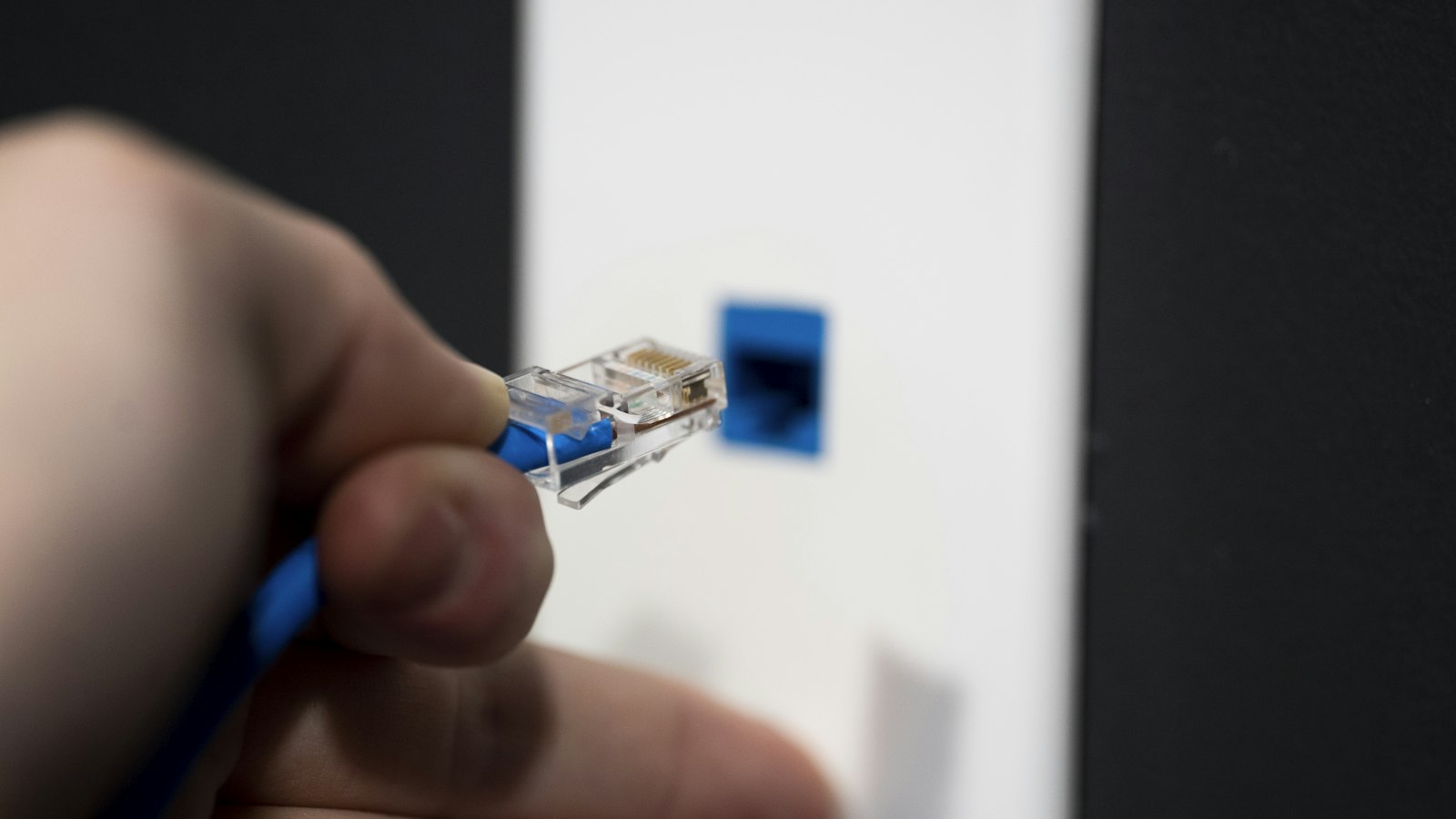
Buying cable by the box is far cheaper than buying patch leads, and it lets you cut every run to the length it needs. The catch is that someone has to put the ends on, and a bad termination is one of the most common causes of a link that negotiates at 100Mbps instead of Gigabit, drops under load, or will not carry PoE. Two inexpensive tools take most of the risk out of it.
A ratcheting pass-through crimper
With traditional RJ45 plugs you trim the eight conductors to length, push them into the plug blind, and hope they all reached the contacts in the right order. Pass-through plugs let the conductors run right out through the front of the connector, so you can see the color order before you commit, and the crimper trims the excess flush as it crimps.
The Klein Tools VDV226-110 is the one we would hand to someone doing this for the first time. It strips, cuts, and crimps in a single tool, handles pass-through RJ45 plugs as well as standard RJ11 and RJ12 phone connectors, and has a full-cycle ratchet that will not release until the crimp is complete, so a half-squeezed connector is not possible. There is a wiring diagram printed on the tool itself. Buy pass-through plugs that match your cable: Cat6 conductors are thicker than Cat5e, and plugs sized for one do not seat properly on the other.
A cable tester, used on every run
A cable can look perfect and still have two conductors swapped or one not making contact. You will not see it, and the equipment may still link up at a lower speed without telling you why. The Klein Tools VDV526-100 LAN Explorer checks a terminated cable with one button and reports pass, miswire, open, short, or shield status on LEDs. The remote unit clips into the body of the tester, so it is still there when you need it. You plug the tester into one end, the remote into the other, and you know in a few seconds.
Be clear about what this class of tester does. It verifies that each conductor is connected to the right pin. It does not certify that the run meets Cat6 performance at a given speed, which takes a far more expensive certification instrument. For an office or home install, wiremap testing catches the great majority of real faults. For a contract that specifies certified cabling, hire the certifier or the contractor who owns one.
Wiring order: pick T568B and stay with it
Holding the plug with the clip facing away from you and the contacts up, the T568B order from left to right is:
- White/orange
- Orange
- White/green
- Blue
- White/blue
- Green
- White/brown
- Brown
T568A swaps the orange and green pairs and works just as well. What matters is that both ends of every cable use the same standard, and that the whole site uses one. T568B is the more common choice, so unless an existing installation already uses A, use B.
The mistakes behind most bad terminations
- Untwisting too much. The twist is what cancels interference. Keep each pair twisted to within about a centimeter of the contacts.
- Crimping onto the conductors instead of the jacket. The outer jacket should reach inside the plug so the strain relief clamps it. If you can see loose pairs behind the connector, cut it off and redo it.
- Nicking the conductors when stripping. Score the jacket and snap it rather than cutting through. A nicked wire works today and breaks in six months.
- Putting plugs on solid cable for permanent runs. Solid-core cable in walls and ceilings should end in a punch-down keystone jack or patch panel, with a factory patch lead from there to the device. Plugs crimped onto solid cable are the least reliable joint in the system.
- Using copper-clad aluminum cable. CCA is brittle, terminates poorly, and behaves badly with PoE. Our bulk cable guide explains how to avoid it.
- Not testing before closing the ceiling. Test every run while you can still reach it.
When to hand it over
A few runs in a small office are well within reach with these two tools and some patience. A full building, with a rack, patch panels, labeling, and cameras or access points on PoE, is a different scale of job, and it is one we do regularly. If you would rather have it designed, pulled, terminated, and tested by people who do it every week, get in touch. If your runs are going to carry power as well as data, our PoE switch guide is the next thing to read.